
Where Madison County Arrest News Appears
Local crime coverage here follows events, not a full booking feed. RiverBender covers arrests and incidents across Alton, Granite City, Edwardsville, and the rest of the county. The Telegraph leans on crime, court, and public-safety reporting. EdGlenToday rounds out the Metro East picture with police activity and U.S. Marshals Service operations. Each outlet runs on its own schedule.
For the records themselves, start with the Madison County Sheriff's Office, the Madison County Jail Inmate Inquiry, and the Madison County Circuit Clerk court search. The sheriff also posts news, tips, and safety updates through its app and social accounts. Those channels do not amount to a complete booking feed.
A news article is a snapshot from one moment. Its wording may cover an arrest, a warrant, a filing, a detention hearing, or a later court date. Those are different things. The official roster answers who is in county custody right now, and the court record tracks the case after booking.
Official Madison County Sources First
The sheriff's office runs the jail. It also keeps the arrest and investigation records. Its public Jail Inmate Inquiry lets you search by name, subject number, booking number, In Custody status, a booking date range, and facility. A result can include a Photo column, custody status, a scheduled release date, physical descriptors, and a Multiple Bookings marker. Not every entry comes with an image. The county posts no universal update or retention schedule.
Pick the right tool for the question. In Custody answers whether someone is marked in the county facility. Booking From Date and Booking To Date narrow a recent event or a multi-day sweep. There is no named same-day feed. There is no verified public daily arrest log for Madison County either. Someone can also be released, transferred, held in a municipal jail, or booked under state or federal custody. In those cases the person may simply not show up where you expected.
The sheriff's iOS app and Android listing cover news, safety information, crime reports, and tips. Neither one offers a roster or a booking-photo search. The court side belongs to the Circuit Clerk. A docket shows case details, hearings, bond entries, and the disposition, which is the legal outcome: dismissal, acquittal, supervision, plea, or sentence. Follow the Clerk's copy-request instructions when you need a durable copy. Keep the two records straight. A docket will not confirm live custody, and the roster will not decide a court outcome.
A state sentence changes the map. In that case, the Illinois Department of Corrections, or IDOC, individual search is the separate state locator. It is not a county booking feed. It offers no public booking-photo field either.
Madison County Outlet Comparison
These outlets serve different purposes. Official channels come first because they name the record custodian. News outlets add reporting and context. Secondary listing pages may copy booking details, but they cannot prove anyone is currently detained.
| Outlet or channel | Coverage | Photos? | Where to check |
|---|---|---|---|
| Madison County Sheriff | Agency announcements, public-safety information, tips, jail and records context. | Social posts are not a complete photo feed. The official jail inquiry can show a Photo column. | Sheriff’s Office and Inmate Inquiry |
| RiverBender | Countywide, Alton, Granite City, Edwardsville, task-force, arrest, and court stories. Event-driven. | Some stories carry agency, police, or news images. A photo is not guaranteed to be a booking photo. | RiverBender news Granite City arrest example |
| The Telegraph | Recurring local crime, arrest, court, chase, and public-safety reporting for the mapped cities and nearby areas. | Photos may be news or police images. Coverage is not a same-day custody feed. | The Telegraph news Madison County chase example |
| EdGlenToday | Alton, Edwardsville, and Metro East event coverage, including APD and USMS-related stories. | Some stories use booking, police-supplied, or ordinary news photos. | EdGlenToday Alton police example |
| County-local secondary pages | Copied booking or arrest entries with varying windows, archives, fields, and update claims. | Some pages display copied photos. They are unofficial and may be stale or incomplete. | Use only after the official roster, agency, and court sources. |
The RiverBender Cross-River task-force story below is a local news example of event-driven county coverage.
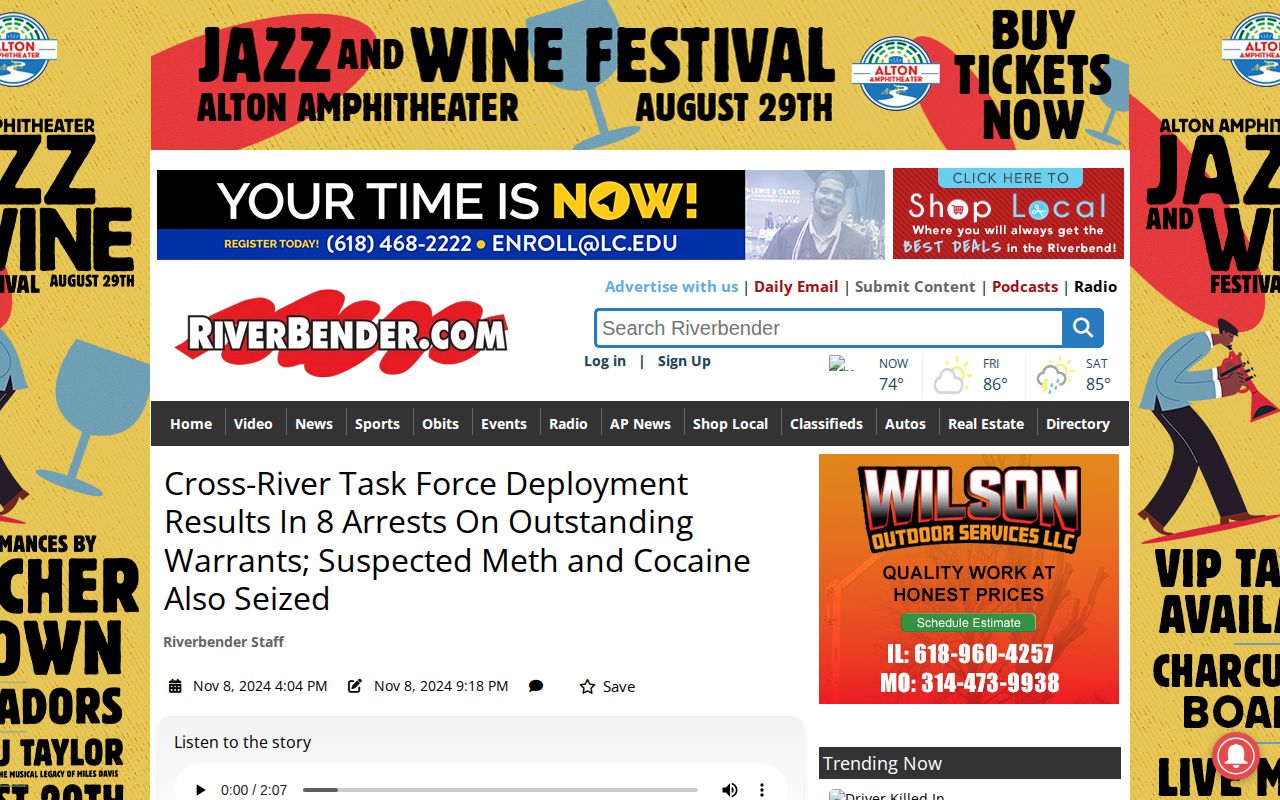
The capture is a news page, not a booking roster. Follow its agency and court references to the official record.
Why Cross-River Stories Branch
RiverBender's Cross-River Crime Task Force story makes a good Madison County example. It covers a deployment that netted eight arrests tied to outstanding warrants, plus suspected methamphetamine and cocaine. Behind that single article sit several players. Task-force officers, a city police department, the county jail, and the Circuit Clerk each hold a piece.
No one source holds the whole story. The task force may report the operation. A municipal agency keeps the arrest report. The jail may hold the person after transfer. The docket may later show a different charge, a dismissal, supervision, a plea, or a sentence. The city pages keep those paths separate: Granite City Busted Mugshots, Edwardsville Busted Mugshots, and Alton Busted Mugshots each track their own police and custody details.
So a story can be accurate about the event yet thin on custody or outcome. Dates, agencies, and court terms tell you more than a headline ever will. Treat the article as a lead to the next record custodian.
How Booking Photos Reach Madison County News
Where does a booking photo in a Madison County news story actually come from? Sometimes a police department handed it over. Sometimes it came from a jail record, a department handout, or plain editorial photography. Check the caption and credit line. A picture next to a charge tells you nothing certain. It may not have come from the county roster. The person may already be out of custody. The shot may be old. Newsrooms can report an arrest with no photo at all.
Illinois also sets a firm deadline for this material. Under 5 ILCS 140/2.15, covered records held by a state or local criminal-justice agency must be provided as soon as practical, and in no case later than 72 hours after the arrest. The statute lists what can be included: identification, age, address, a photograph when available, charges, the time and place of arrest, the arresting agency, and whether custody was received, discharged, or transferred.
The same law carves out exceptions. Interference with an investigation, safety concerns, correctional-facility security, and juvenile or confidential information can all justify withholding. There is also a narrow restriction on agencies posting certain booking photos to social networks for petty, business, Class C, or Class B misdemeanors, unless a clear public-safety purpose exists, such as finding a missing person, a fugitive, or someone wanted for a more serious crime. That limit is narrow, not a ban. It is not a promise that every photo is public either.
From a Madison County Story to the Record
Treat any Madison County story that names a person or agency as a map, not a destination. Write down the article date. Write down the exact wording used about the arrest, booking, release, warrant, or court proceeding. Then match the event to the right facility and the right court. The Madison County record search covers the countywide booking and roster picture. Keep one thing in mind: a county result is not a master list of every municipal, state, federal, or immigration event.
- Save the story URL, publication date, agency name, person’s name as printed, and any case or booking number. Note whether a photo caption says booking photo, police image, or news image.
- Check the Madison County Jail Inmate Inquiry by name, subject number, booking number, custody status, or booking-date range. Compare more than a name, including the agency and available identity fields.
- If the county result is empty, identify the arresting and receiving agencies. Granite City, Edwardsville, and Alton keep separate police records, and Alton operates a separate municipal jail that can hold city, state, and federal inmates.
- Search the Madison County Circuit Clerk for the case and later docket activity. A news charge can change, and a docket entry is the stronger source for a disposition.
- Request the missing record from the custodian. A focused request can identify the booking date, booking number, agency, facility, and the separate items requested, such as the booking record and booking photograph.
Timing separates these sources. Someone just booked may not show up in the roster immediately, since Madison County promises no fixed refresh schedule. A person can drop off the "In Custody" result while a date-range event still appears, or the event can vanish from the public interface entirely. Meanwhile, a local article can linger online long after a release or transfer. None of these clocks run together.
Getting an official copy means asking the right office. The Clerk's copy-request instructions handle court documents. For a county booking record or photo, go through the Madison County Public Records Center or the responsible agency's own request process. A request only works when it lands with the correct custodian.
Secondary Madison County Listing Sites
Unofficial booking sites sit at the back of the line. They rank behind the sheriff, the jail, municipal facilities, and the courts. Many simply copy a record from an agency or from another site. Their fields, dates, photos, archive depth, and correction policies all shift over time. A copied listing confirms nothing about current custody or how a case ended. Use them only as leads. Take every detail back to an official source.
- Busted Newspaper’s Madison County bookings page presents a county-local index with pagination and fields such as booking date, agency, charges, and a photo when included. It describes itself as unofficial and can contain stale or incomplete material.
- Recently Booked Madison reported a 30-day local window and multiple daily refreshes at the research check. Its profile fields are site fields, not a promise from the Madison County Sheriff.
- Mugshots.com’s Madison County page is an historical archive-style source with older year navigation. It is not a same-day jail roster.
- Mugshots Zone’s Madison County page uses local agency tags and recent or archived entries. Its dates and fields are controlled by the publisher, not by the county.
- Illinois Arrests is a statewide service. Research did not verify a working Madison County local page, so it should not be presented as a county feed.
A copied entry can outlive the official page it came from. It can also leave out a record the agency would confirm on the spot. So never rehost these photos or turn the pages into a gallery. If a copy is wrong, or a legal status shifts, follow the source's current correction instructions and lean on the official court or agency paperwork. A paid intermediary is not an official records route.
Madison County Charges and Dispositions
A booking, a headline, and a photograph freeze one moment. Charges can change from there. They get reduced, amended, or dismissed, and cases end through acquittal, supervision, a plea, or another court order. The person may be released or transferred while the case is still open. Treat the arrest as the start of the story, not the end.
Be precise about what a source actually says. "The article reported an arrest" is not "the court found." Likewise, "the roster marked the person in custody when checked" is not "the person is still held." The court docket follows the case itself, while the jail or municipal facility answers the live custody question. Keeping those apart protects the record and stops a news story from carrying more weight than its source can bear.